
When approaching retirement, many people assume their investment portfolio should become more conservative. But the right investment strategy depends on more than just age. It needs to reflect how much income someone requires, how long their retirement may last and what they want their retirement to look like.
This was particularly important for Bob Brown (for illustrative purposes only), a prospective client who came to us at age 64 while preparing to retire. He was interviewing several advisory practices before deciding who would manage his retirement savings and help him navigate the next stage of life.
Understanding Bob's Retirement Goals
Bob had built up significant home equity and accumulated approximately $1 million in investments. His financial picture looked as follows:
Home: Approximately $2.1 million
RRSP: $800,000
TFSA: $200,000
Employer pension: $2,000 per month
CPP: Eligible for approximately 80% of the maximum benefit
OAS: Eligible to begin receiving benefits at age 65
Inflation: 2.5%
Bob wanted approximately $7,000 per month in after-tax income to maintain his desired retirement lifestyle. Just as importantly, he wanted to remain in his home for as long as possible and ideally never have to sell it to fund his retirement.
This meant developing a plan that could provide reliable retirement income while preserving his ability to stay in his home.
Looking Beyond a Traditional Retirement Portfolio
Other advisory practices had proposed a Moderate investment portfolio, consisting of approximately 60% equities and 40% fixed income. This is a common approach for someone approaching retirement, as it aims to balance investment growth with lower volatility.
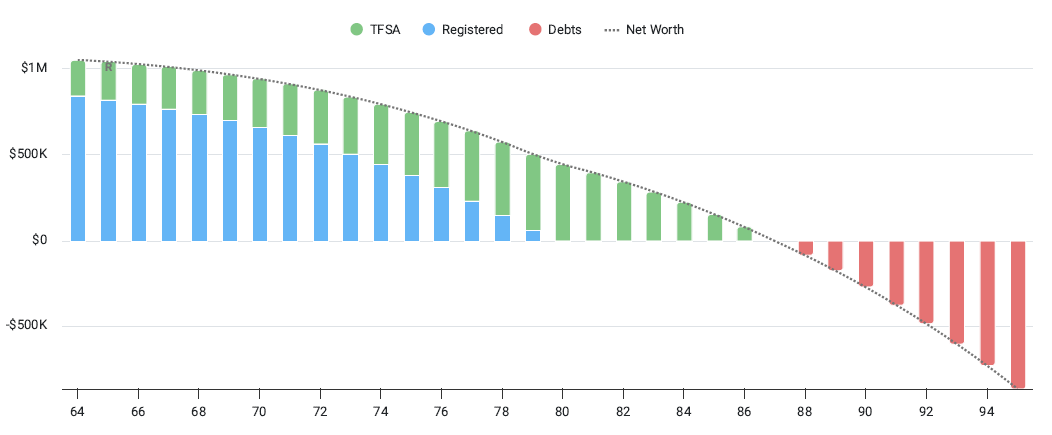
However, when we modelled Bob's retirement income requirements using this approach, assuming an average annual return of 5.2%, the projections suggested his investment portfolio could be depleted by approximately age 87.
Given Bob's good health and retirement goals, we believed planning only to age 87 wasn't sufficient. We wanted to build a plan that could support him through age 95, helping reduce the risk of him outliving his savings.
This required looking at his investment strategy differently.
The Impact of Investment Strategy on Retirement Longevity
The difference between these two investment approaches becomes clear when comparing the long-term projections.
Moderate Portfolio – 60% Equity / 40% Fixed Income
Assumed average annual return: 5.2%
Snap Projections
Under this approach, Bob's investment savings were projected to be depleted around age 87**. While he would still own his home, he would no longer have his investment portfolio available to support his retirement income needs.
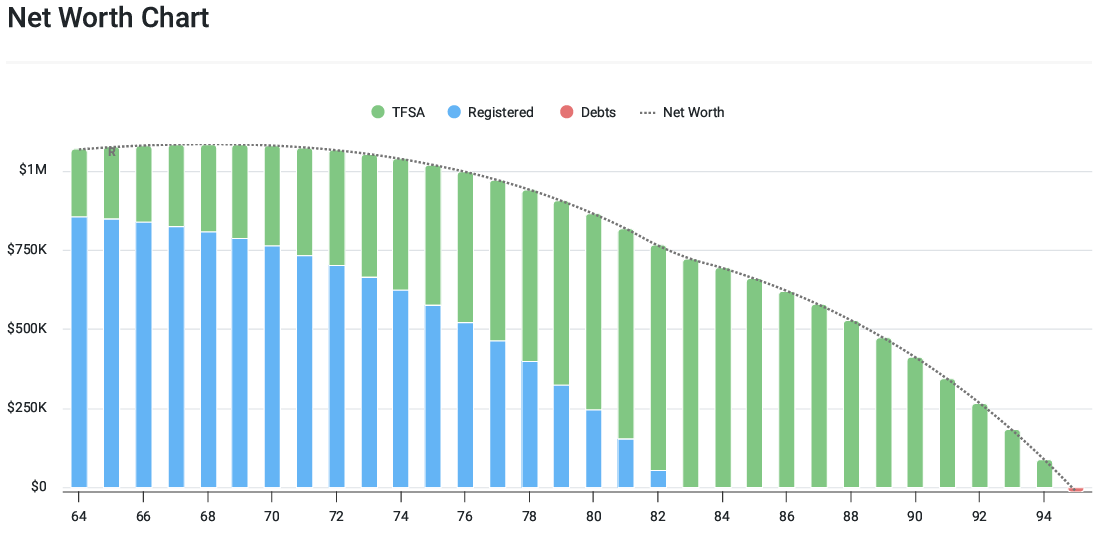
Growth Portfolio – 80% Equity / 20% Fixed Income
Assumed average annual return: 6.8%
Snap Projections
By comparison, the Growth portfolio extended the projected longevity of Bob's investments by approximately eight years, allowing his retirement assets to last until age 95**.
This was a significant difference. It meant Bob could work toward maintaining his desired lifestyle, continue living in his home and avoid having to rely on selling his property to fund his retirement.
Our Recommendation: A Growth-Oriented Investment Strategy
After reviewing Bob's retirement goals and running various financial projections, we recommended a Growth portfolio consisting of approximately 80% equities and 20% fixed income. While this approach involves greater short-term market volatility, it also provides greater exposure to investments with higher long-term growth potential. Based on our planning assumptions, we used an average annual return of 6.8% for this portfolio, compared to 5.2% for the Moderate portfolio.
This difference in assumed long-term returns had a meaningful impact on Bob's retirement projections. It provided the additional growth potential needed to support his desired retirement income over a longer planning horizon.
We discussed the added volatility that comes with a Growth portfolio and the importance of being comfortable with short-term market fluctuations. However, we also explained that taking an appropriate level of investment risk can be important when the goal is to generate sufficient long-term returns to support a retirement that could last 30 years or more.
The objective wasn't simply to take on more risk. It was to find an investment strategy that better aligned with Bob's long-term financial needs.
Managing Volatility Through a Cash Wedge
We recognized that a Growth portfolio would expose Bob to greater short-term fluctuations, particularly during periods of market uncertainty. To help manage this, we incorporated a strategy known as a cash wedge. We recommended setting aside approximately 6 to 12 months of the income required from his investment portfolio in a high-interest savings account. This money would be used to fund Bob's monthly income needs as they arose.
The benefit is that Bob wouldn't need to sell investments to generate cash during periods when markets are down. Instead, he could draw from the cash wedge while giving the remainder of his portfolio time to recover.
This approach helps reduce the risk of being forced to sell investments at unfavourable prices during a market downturn, while allowing the bulk of his portfolio to remain invested with a longer-term focus and participate in potential market growth and recoveries.
It also provides greater predictability for Bob's monthly cash flow, helping him feel more comfortable with a portfolio that will naturally experience higher levels of short-term volatility.
The Outcome: A Retirement Plan Built Around What Matters Most
The difference between the two approaches wasn't simply the amount of investment risk. It was the difference in whether Bob's retirement savings could support the lifestyle he wanted over the course of his retirement. By looking beyond a traditional age-based investment approach, we were able to identify a strategy that better aligned with his long-term goals.
Our recommendation combined:
A Growth-oriented portfolio: Designed to provide greater long-term growth potential and support a longer retirement. It also allows Bob to have additional funds for healthcare costs that come up later in life (example: long term-care).
A cash wedge: To fund monthly income needs and help avoid selling investments during periods of market volatility.
A retirement income strategy: Designed to support approximately $7,000 per month in after-tax spending.
A longer-term planning horizon: Targeting financial sustainability through age 95.
For Bob, this meant having a retirement strategy designed to support his desired lifestyle, preserve his financial independence and maintain the goal of staying in his home without needing to sell it to fund retirement.
The biggest takeaway: Retirement planning isn't necessarily about reducing investment risk as much as possible. It's about taking an appropriate level of risk to give your money the best opportunity to support the retirement you want.
Jack Fournier B.Sc, FMA, CIM®
Portfolio Manager | iA Private Wealth
Insurance Advisor | iA Private Wealth Insurance Agency*
700-609 Granville St. Vancouver, BC
p: 604 895 3348
jack@beaconwealthpartners.ca
Travis Kidson, B.Sc, CFP®, CIM®
Portfolio Manager | iA Private Wealth
Insurance Advisor | iA Private Wealth Insurance Agency*
700-609 Granville St. Vancouver, BC
p: 604 895 3486
travis@beaconwealthpartners.ca
This information has been prepared by Travis Kidson and Jack Fournier who are Portfolio Managers for iA Private Wealth Inc. and does not necessarily reflect the opinion of iA Private Wealth. The information contained in this newsletter comes from sources we believe reliable, but we cannot guarantee its accuracy or reliability. The opinions expressed are based on an analysis and interpretation dating from the date of publication and are subject to change without notice. Furthermore, they do not constitute an offer or solicitation to buy or sell any of the securities mentioned. The information contained herein may not apply to all types of investors. The Portfolio Managers can open accounts only in the provinces in which they are registered.
This article is a general discussion of certain issues intended as general information only and should not be relied upon as tax, legal or investment advice. Please obtain independent professional advice, in the context of your particular circumstances.
iA Private Wealth Inc. is a member o the Canadian Investor Protection Fund and the Canadian Investment Regulatory Organization. iA Private Wealth is a trademark and business name under which iA Private Wealth Inc. operates.
*Insurance products are provided through iA Private Wealth Insurance Agency which is a trade name of PPI Management Inc. Only products and services offered through iA Private Wealth Inc. are covered by the Canadian Investors Protection Fund.
** The projections presented are illustrative in nature and are not a guarantee of future results. They are based on assumptions regarding investment returns, inflation, taxation and other relevant variables, which are assumed to remain constant throughout the projection period. Actual results may differ materially from those illustrated due to changes in market conditions, economic factors, tax legislation and other unforeseen circumstances.
Beacon Wealth Partners is a personal trade name of Jack Fournier and Travis Kidson.